Saturday, May 20, 2023

BSSS - Session 14

Summary

The campaign goes on pause and the Hedgehogs of Mercy settle in after the big battle. 

  • Shimsusa the Archer - 3rd Level Fighter
  • Enlil - 1st Level Elementalist Sorceress
  • Alorus - 1st Level Vivimancer Sorcerer
  • Maru the Witch - 4th Level Diabolist Sorcerer
  • Athra - 4th Level Fighter

Session Recap

After the battle produced a relatively clear victor the party got to have some Downtime in order to handle everything that happened. The first thing they did was to go inspect the Pale Portal housed in the previously unvisited section of the city, beyond the Temple District. 

Said district was itself being in the process of being utterly demolished. The Great Temple dedicated to the Pale Stillness of Justice, the Law-aligned patron of the city, had shattered by itself upon the death of the Voice of Stillness during the battle, and the subsequent magical energies released from the disrupted ritual. However, the powers of the Decomposition didn't feel like leaving things half-done, and so employed their forces to systematically level and desecrate all the temples there, permanently severing the city's connection to it's patron.

The Hedgehogs of Mercy were offered a selection of various magical items the chaos priests had found as they were doing their work, allowed to pick one as gratitude for their assistance in the battle. After some deliberation the party picked a masked iron helmet in the shape of a wolf's head. Once they walked past the new gutted gatehouse, they found themselves in the part of town unseen by most. 

The party of the city where the Pale Portal is located.

The entire section of the city was just a field, with no houses or buildings, and from wall to wall covered in the bleached bones of countless dead, along with some more recent corpses. In the middle of it all stood the Pale Portal itself, a 4ish meter tall structure of stone and bones, in the middle of which was a silvery glittering substance which seemed to block the view of anything behind it.

The Pale Portal itself.


After some experimenting and going back and forth through it, Alorus the Vivimancer decided to just go right in. First he stepped through into a dark room, and once he went back and got a lamp, stepping through a second time resulted in him falling through the portal and out into a clear sky. He was, for all intents and purposes, gone. 

Meanwhile the rest of the city was in lower c chaos too. Bel of the Lotus, the vampire noble and friend of the party, had gathered the remaining nobles of the Undying City and went on a killing spree of his own - finishing off as many of the old priests of the Pale Stillness that they could find, along with their retinues and, of course, a bunch of just random people standing by because why not? In the end he declared himself the new ruler of the Undying City, his claim backed by surviving noble houses ( who were eager to actually get back to having any real power) the Golden Fraternity (who were quite happy to have an actual noble from the actual old Empire in power) and the priests of the Decomposition (who were willing to allow him to do that since he seemed uninterested in reestablishing the city's connection with the forces of Law). 

The characters were invited to the talks, and Bel offered to essentially have the entire company of the Hedgehogs join him as his personal bodyguards and advisors. Everyone agreed, with Athra the fighter even being arranged a marriage into one of the noble houses, as an opportunity to get him into the Noble caste and from there allow him to achieve what he wanted in the long term - control over the armies of the city. 

Shimsusa the Archer, while thankful for the offer, decided to instead travel back south to the Bastion of the Raging Bull with intentions of joining the Bull Guards and Utu. When she arrived, awaiting for her at the inn the party had stayed at was an ominous threat, clearly from the invisible assassin that had slain Esho a few months ago. 

Observations

Well, this is it for now. I was planning on keeping the campaign going for another 3-4 sessions, before I have to leave for a few months and thus will be unable to run it. However, the next month and a half is shaping up to be rather busy and the situation in the campaign has gotten rather complex, with multiple factions and different elements all requiring more attention than I have available. 

My players seem to be generally okay with ending it here, especially after the high note of the big battle last session. It just makes for a natural break point. I have some plans on running Between the Serpents of Smoke & Steel for other people while I am in the US, and if that happens I will be posting recaps of that as well, however the in-person game is now on hold. Will I come back to it? I have no idea. 

I do plan on writing up some overall campaign impressions for this in the coming month or so, similar to the ones I posted about the Greylands, my previous campaign. I also have plenty of broader observations about the game - from system to setting and simple GM organizational stuff, which will hopefully be interesting for at least someone else to read!  

And this is it. The Hedgehogs of Mercy (god what a ridiculous name!) are, for now, in retirement. 

Monday, May 15, 2023

BSSS - Session 13: The Battle for the Undying City

Summary

We play out the big fight between the forces of Chaos and the Undying City's defenders using a tabletop wargame that I created for the scenario. 

Session Recap

Well calling this a session might be a bit wrong, but here we go. Since I could not get a full 6 player count for the wargame, I ended up participating as well. The way I have the game structured, both Chaos and Law each have 3 distinct bands of units, the control of which was split up between the players. 


Initial setup of the scenario.

The wargame itself begins mere moments after the events of Session 11. The party has just broken open the inner Gatehouse of the Eternal Bridge, and the forces of The Decomposition and their allies have swarmed into the city. With the Ritual Procession still not actually gathered in one place (various small processions leaving from different parts of the city to gather in the middle), the Chaos forces had to figure out what their general plan was going to be. 

In the scenario Chaos has 2 victory conditions. A Minor victory if they can remove all 12 Ritual Procession counters from the board by Turn 6 of the game, and a Major one if they can kill the Voice of Stillness, the otherworldly being that controls the Undying City in the name of its master The Pale Stillness of Justice. Law, conversely, only has one Major victory condition - Complete the Ritual. 

With Turn 1, things immediately went in Law's favor. The Blue band, the one that contains all the Procession counters, the Civilians and, most importantly, the Voice of Stillness itself, had the first activation. This allowed them to pull back some of the Citizens that were in the way of the Chaos forces, and bring them safely back into the Temple District. A very important move, as the Voice of Stillness needs to sacrifice a Civilians token every time it attempts to advance the Ritual, successfully or not, and it begins the game with not having enough sacrificial victims on hand to complete it. 

From there, Chaos decided to focus on the Ritual Processions then, which both works into their minor victory condition, and also makes performing the Ritual action a bit more uncertain for the Voice of Stillness. That and breaking into the temple district is quite difficult, with all forces having to be funneled through the streets and a very easy to defend gatehouse. 

The city's defenders sent out a properly huge stack of units out into the Great Market plaza to fight off the forces of Chaos, who in turn responded by summoning a rain of acid over the entire place, reducing every single unit that was in the area. This is done by placing a Miasma counter in the area, one which saps the strength of full units (or even kills reduced ones) and stays there for 2 entire turns, suddenly making the most central space in the board, the one which most roads go through, kind of an awkward place to move through. 


The beginning of Turn 2.

As Turn 2 began, Chaos was actually not looking too hot. While they had managed to take out some parts of the procession, it was not enough to actively hinder the Ritual from being advanced, and their nuclear solution at the Grand Marketplace meant that actually going around and doing anything was difficult as their own units would have been equally affected by the miasma that still lingered.  Law was generally looking in a strong position - well defended inside the Temple District, having enough sacrificial fodder to complete the ritual, and mostly just needing to bide it's time. 

Chaos, conversely, was on the back foot. They lost some of the Slime Priests, which was a problem as they are the primary way the Chaos forces could bring in more reinforcements. 

As Turn 3 started though, things changed. the Miasma had cleared, finally, and the giant stack of slimes, oozes and jellies, lead by the horrific Slime Titan now had the chance to actually move through the central market. 

Additionally, the force of Law decided to take on the offensive and, being lead by the 3 units of High Priests, rushed out and attacked one of the last remaining units if Slime Priests. However, Law's fortunes quickly turned at that moment. With the Temple district now vastly underdefended, the Slime Titan shuffled its lesser cousins through the city, devouring everything in its wake. Soon it broke through the Temple Gatehouse, and while the Voice of Stillness was hurling magical attacks at it, it only weakened the group, rather than demolish it. 

Finally, the oozes swarmed into the Great Temple. After a quick fight everyone was dead, except for the Voice of Stillness which had been reduced in strength and had to retreat away. Things were dire, but not impossible - as long as Law got to act next, they had plenty of spells that could wipe out the big green tide, allowing them to both stabilize and severely reduce the chances of Chaos to act in future turns.


That, however, did not happen. With Chaos still being on the initiative, and the Hedgehogs of Mercy, the band of player characters in the Between the Serpents of Smoke & Steel, having quietly also made their way into the Great Temple, the time of Law had come to an end. The Hedgehogs seeing the chance to end this Ritual for good summoned forth a spell and struck down the Voice of Stillness, shattering the control of Law over the Undying City. The game finished only halfway through Turn 3. 

Final state of the game as of Turn 3. The Voice of Stillness was in the Temple District Area which has a unit of yellow Archers in it.

Observations

This, I think, was a rousing success. While I am generally very pleased with how the wargame itself works, and have had several people now tell me that it just works really well as a stand alone wargame (and even 2 of my players expressed an interest in playing it again in the future, just as its own thing!), it is always nice that it actually worked on the one "official" playthrough that it was designed for.

The game definitely took way longer to play as a 3v3 team game, rather than a simple 1v1 game as I've played it so far in my playtesting sessions with other people. As people were still learning how to play this and also consulting with their team mates, there was a lot of time spent simply discussing potential moves rather than making them. That's fine, though it did mean that a 2 and a half turn game took nearly 4 hours, when 1v1 playtests I've done before took about 2 hours to complete the game (usually going up to Turn 5 or so).

The bit of game design I am most proud of, and one which my players also appreciated in having really captured the spirit of things, was how the Hedgehogs of Mercy were used in the game, being a sort of strike team that Chaos or Law can use to mess with the other side, plus the absolutely perfect storytelling beat of having the Hedgehogs themselves be the ones to land the decisive killing blow on the Voice of Stillness also really helped. 

So, with this I am now happy to have the game just be something I can play with friends now and again if I want to, and I think this helped make my campaign a fun and interesting experience for everyone involved. While the BSSS campaign is going to be winding down soon, due to other obligations on my time, it will always have this high point to look back on! 

Tuesday, May 9, 2023

How I made a tabletop wargame in about a week

 As a direct result of the actions of the players in my current campaign, the Undying City now has a fairly sizeable strike force (calling them an army might be giving them too much credit) of Chaos-aligned cultists that serve the Chaos Lord known as The Decomposition, along with allies they have managed to rally to their cause. And what is that cause? To disrupt the ritual currently being performed in the Undying City which will transform every living being in the city into undead, and in the process (and of actual concern to these Chaos cultists) will completely cement the city as a stronghold of Law in this plane of existence.

Initially, my plan was to simply have the fighting on the city streets happening either in the background or maybe even having the party directly participating in it. However my players have been reluctant to really pick a direct course of action, their current stance mostly being that they want to wait and see which way the fight will go, and if possible try and stop both forces from actually keeping control of the city. 

So I was left in a bit of a dilemma, where in order to logically progress with the game, the battle for the city had to be resolved at least to some degree. Well, I didn't really want to just come up with a way for it to go, or come up with some broad strokes system to simulate it and then just tell my players how it went. Because, after all, this is a gaming campaign. The point is to game!

That got me thinking - I really enjoy tabletop/boardgame wargames. So couldn't I come up with a quick and dirty one to allow my players to actually play out the battle as the commanders of Chaos and Law, and then let them zoom back in on their characters and have them react to the situation? Well yes. Yes I could. And so I did. 

Concepting and Design

So, first things first I had to figure out what the system for this game was going to be. I personally enjoy card-driven wargames, but that would involve way way too many cards to have to design and make, and I did not feel like that was a productive way of doing it. After some quick and rough brainstorming, I settled on using the main combat system (and from there, unit stats) from Brotherhood and Unity, which I've played a couple of times and quite enjoyed and found to be pretty straightforward and light for a tabletop wargame. 

With that I had to determine how the map of the city will be traversed. Initially I was going to use areas similar to the board game Dual Powers, but after actually trying to draw that as a map it just looked way too cluttered and hard to read. Instead I just went with point to point movement, another staple of tabletop wargames, except the ones that use hexes of course. 

From there, I had figure out how to model the two forces involved. The Chaos incursion were easy, as I had previous already written up their numbers and so just used those as a base for my units. With Law I had to finally sit down and figure out just what forces they actually had in the city. 

An interesting design challenge was how to handle all the damn magic-users running around the place. Between the party, the leaders of the Chaos force and the ruler of the city (an otherworldly being known as the Voice of Stillness, and the individual actually casting the ritual of undeath) there were a lot of magical types around. In the end I took another idea from a game I like - Dragon Pass. In that game magical units have a sort of spirit that they project that can be used to perform attacks on other enemies.

In my game this ended up simulating the combined magical attacks or defenses of a unit of magicians. I also came up with Spell Cards, which players can play and usually require a magical unit to be near the target to actually do the spell. 

This whole thing took about 3 days of on and off writing and rewriting of ideas.

Designing the Game Pieces

Next up came probably the most fun part of the project - designing and drawing all the game elements that I would need for the game. In my case that meant creating unit counters, spell attack counters, a playing board, spell cards, activation cards (which I ended up using to determine play order) and then reference sheets for unit special abilities and general game rules. 

One of 3 counter sheets of units for the game.


The unit art is also a direct inspiration and reference to William Church's wonderful and evocative art on the counters of White Bear and Red Moon/Dragon Pass and Nomad Gods. The units themselves are relatively simple (by wargaming standards) as you can see. They have a name, artwork, and then 3 stats - Attack, Health and Movement (a star over one of those indicates some special rule assocaited with it that is listed on the reference sheet). A white bar indicates that the unit is an Individual (as opposed to a group of similar people or creatures), and on the reverse side the counter has a grey bar across it to show that a unit is of Reduced strength. 


The actual game board, representing the Undying City as a series of locations connected by pathways, all broadly aligned with the map of the city I had already drawn.

The board took a few tries to get it looking right, but I am personally pleased with the final result. The color of the location's artwork indicates which part of town it's in (which doesn't really matter for gameplay purposes, but was just a nice visual element), the bar on the bottom indicates what type of Terrain it counts as, as well as the number of non-Individual units that can be stacked in it at the end of an activation. 

Then I included a turn tracker, a Ritual tracker and a chart for terrain and combat for ease of reference during play, along with supply boxes for both sides. There could have been other elements that are worth including in the map, and I might eventually get those printed and pasted onto it at a later date, but for now it has been quite serviceable. 


Spell cards

The drawing and design of the elements took a couple of days of very intense work, and the kind of work I absolutely adore as an artist. Of being completely in the zone, thinking at any given moment about simply opening photoshop again and doing more art! 


Making the physical components 

And next came the hardest part -actually getting these made. In total I made 160+ unit and special counters, and those took a lot of work to cut, a lot of them ended up kind of crooked (inevitable when cutting by hand), but I am generally pleased with them. The board and tokens are also quite large, in fact almost absurdly so by the standards of most commercial tabletop wargames, however it makes them a lot easier to handle when one considers the game can be played with up to 6 players, and it would be helpful if they could actually see what is going on. 


A slightly blurry photo of the board and counters all set up.

This whole process took 2 and a half, almost 3 days total to actually do, mostly because at one point I had to just force myself to take a break since cutting the counters was giving my left arm a very painful muscle cramp (which took about a week to completely clear off).

Playtesting

The final, and often most important, step of any game design is of course playtesting. I played a couple of games by myself, which helped iron out some of the rougher ideas in the activation system, the actions each band of units takes during their activation, and so on. 

I have so far also done two playtest sessions with a fellow wargamer friend of mine, and while there have been minor tweaks in special abilities here and there, the game more or less works quite well, provides various ways for each side to achieve it's victory conditions and offers several not-so-obvious avenues for strategy. I consider all of that a success of design! 


The true and final test, of course, will be once I actually run the game for the players in my campaign. That will happen this upcoming Sunday, and I absolutely plan on writing up a session report for it, though it will of course be rather different than the usual one. But even after that, I am pleased enough with the game (and have had enough of a positive response from my friend) that I will likely keep playing it as a game in and of itself in the future too. 

Sunday, April 30, 2023

Review - Muster, A Primer for War

Time for another review! And since I just finished re-reading Muster, let’s talk about it! This is going to be a bit more rambling as a review than the two modules I did, because, well, it’s a different kind of book!

Muster cover art.

Overview

Muster is a rather interesting read, as it is not really an RPG book or a module. Instead it’s a book of theory and advice on how to place D&D in what the author calls “the wargaming way” - a style of play similar to or adjacent to OSR play, though with some interesting peculiarities. This puts it in a similar category to Philotomy’s Musings, or perhaps smaller works like the Old School Primer by Matt Finch and the Principia Apocrypha.

The book was written by Eero Tuovinen and illustrated by Sipi Myllynen. I am not sure who did the layout and editing, but it is published by Arkenstone Publishing so…someone from there, presumably?

What works for me


I like this book a lot. I mean a lot. It’s 250 pages and I’ve read it twice now, which considering the size of my To Read list is probably unwise, yet here we are.

Let’s try and go over some of the things present in the book, because there’s a lot. The book begins by laying out first off what is meant by “wargaming way”. It is a curious term, as it refers to the old Prussian kriegsspiel which are generally seen as the progenitor of civilian hobby wargames that came in the century or two after it.

On one hand, it is rather odd why this term was chosen, as opposed to simply using the much more popular label of OSR. However I think since this method of play was developed within a relatively small group of Finnish gamers (from what I can gather from the text at least), I think it is also okay to give it a distinct name.

Next up the book presents the basic tenets of the Wargaming Way of play, divided into a Basic Outlines portion and an Advanced Matters portion. The Basic Outlines covered are things one can find in the other theory or instructional texts that I linked above - do not fudge dice rolls; always start at 1st level; the importance of the campaign as a coherent world rather than an individual character or party of characters; goal-based XP (usually 1 exp point for 1 gold. We’ll get to this later); player-driven gameplay and general disregard for formal rules texts in any situation where they do not actively contribute to helping run the game.

One thing that is a common feature of OSR pedagogical texts and has become a common mantra, and yet is missing from this text, is the whole “combat is a fail state” declaration. The book does not seem to agree, with that combat is in fact often the entire point of the specific scenario or situation set up by the GM for the players, and figuring out how to tackle it in a way which can lead to victory may be the entire point.

The book also covers stuff like Dungeon Doctrine and how a group can go about developing it - how to open doors, how to explore corridors, how to react to given situations. The kind of play that groups playing in high-lethality dungeon crawling scenarios tend to quickly learn how to do simply so they don’t just get wiped out every 10 steps.

There is also advice for the GM on how to set up this type of game, denoting two forms of campaign - the basic and extended campaign. The basic campaign consists of simply picking a module, running players through it, then picking another one, and then another one and so on. The extend is what is commonly called “sandbox” play where you have a wide open world through which the players are free to explore and direct the game.

I do wish the book actually went into a bit further detail on how to actually do the work of organizing this however. Of course every Referee’s workflow on preparing a campaign is slightly different, but outlining good common practices to keep in mind like how to organize players, how to keep track of time, location and note taking, how to incorporate modules that do not quite fit with your world’s setting into it - those are all good pieces of advice I think would have fit quite well within this book.

Next up a thing that I like is a small chapter titled D&D and Chauvinism which covers D&D’s ties with adventure fiction of the early 20th century and the implication that has for what kind of stories D&D tends to replicate - tales of colonialism, imperialism and so on. If you’ve read anything by Traverse Fantasy or Zedeck Siew you probably already know all this stuff. The book also does come to the same conclusion that I have come to regarding all of this, which is that attempting to seek some kind of political (or god help you, moral) purity through playing elfgames is probably misguided and it’s a lot simpler to just acknowledge that the characters in these games are, well, amoral (if not immoral) assholes.

The inclusion of this chapter is one I feel was a good call. While it is mostly unrelated to the rest of the text and feels a bit shoved and out of place…that’s also kind of the point, I feel. It acts as a good stopping point for the various flavors of self-deluded reactionary elements in the OSR. And anything that reminds those people that they’re fucking idiots is alright by me!

Other things of note - the text comments on experience points and their importance to the wargaming method on numerous occasions. It instructs using exp as more or less a victory points score in an old arcade game. An indicator of how far you’ve gotten and how well you’re doing in the game. The book is very very clear that experience points should be earned through clearly predefined goals, and not as participation awards or awards given for doing any out-of-game activity.

While I do agree with this sentiment to some degree… I also give experience in my current campaign for numerous activities such as carousing, players doing mapping, acting as a quartermaster or as a caller or writing session reports. However my reasoning behind giving experience of those things is that that experience acts, in its own way, as a teaching tool - it rewards what I consider good practices for players in an OSR play style.

An interesting aspect of this approach to XP is that I did not find anywhere in the book a mention of giving experience points based on enemies defeated or killed. The only concrete example is giving exp for treasure retrieved (the typical 1 gp = 1xp practice found in a lot of OSR games). I am not sure if that is a deliberate omission or simply one that was not mentioned but still used. The whole “goal-oriented exp” thing is also something I’ve been thinking about as well in my own campaign. In the session where my players were attempting to break into and disable the garrison of a gatehouse I had decided early on that they were not going to receive experience points for killing the guards or the loot they foud in the gatehouse, as giving experience for that means that the next logical step would be simply murdering people in the streets for exp too. However, as you see in the Observations part of that session recap, I also in the end decided to grant the party exp based on the fact that they had a specific goal for this session and they managed to achieve it.

So I suppose I do see the value in goal-based experience points, however this is another case where I wish the book actually laid out a much more practical example of “This is how this Referee in our game used experience points” and lay out what kind of goals were used in the game as well as what kind of experience points were given. I suspect not a lot of exp though, considering that the book says that getting a character from level 1 to level 2 takes about 10 to 12 sessions of play!

There are a few “war stories” sprinkled throughout the book of various players from that play group discussing situations that occurred in the campaign(s?) they’ve played in over the last few years, and used as illustrative examples of the wargaming way. They’re neat, and also can easily be skipped which I think is probably the best way to handle these types of stories. They did, however, offer some amazing bits of writing like the party in one game deciding they will bring down a group of body-possessing witches by…framing them for witchcraft. Or the curious cultural touchstone of the module B9 Caldwell and Beyond and its place in Finnish D&D culture.

The last thing I’d like to single out to comment on is what the author terms the Nihilistic Void, which is the strange situation that results in this style of gameplay - the fact that the Referee, despite moving the enemy pieces, should ideally not actually play as an enemy of the players. Which then means that the players simply are struggling against the void of failure itself. The book spends a few pages discussing the implications of losing characters and the emotional impact it has, and I’ll admit that this is something that I’ve struggled with on how to handle as a referee myself.

There is a lot of good in this book, and honestly, for me to cover all of it would be to essentially write a very messy synopsis of every chapter, so let’s move on.

What doesn’t work for me


I have only one main criticism of the book, and that’s to do with layout. While the actual text itself is laid out perfectly well and is easy to read, at some point there was an odd decision made to include these pages of schematics which are, at least in theory, supposed to visualize what the text around them is talking about.

This is not really helping.

However the issue with them is twofold. First off they just kind of don’t do a good job at actually explaining the text in a visual way, and I personally found the more confusing than the actual body of the text, not less. Secondly, they are inserted often right in the middle of a chapter, basically splitting the text from one page to another, which is not unreadable ro anything, but definitely a baffling layout decision regardless. For my money, they could have easily been moved around to split the text between chapters or topics…or just outright dropped.

The layout issues continue with the fact that the Table of Contents is not really in the beginning of the book. Instead there is a manifesto of sorts for the wargaming way, and only then do you get to the table of contents. I personally would have switched them around.

Lastly, the artwork in the book. The book actually has a surprisingly high amount of art, and some of it in full color (so are the pages of visual aids too, as you can see above). Meaning no disrespect to the artist who illustrated the book, most of this art could have simply been cut. While the actual style of the illustrations itself is sketchy and generally fine for this sort of book, their implementation within the layout and text is mostly just “waste of space”. There has not been a single page in the book which I felt was improved by the inclusion of art in it and so that made the art feel peripheral and sort of just solved in, rather than an actual contributing element to the overall quality of the book.

Beyond these minor quibbles though there is not much really bad with the book. For me at least these were, at best, minor irritants rather than something that actively made me unable to read the book.


Conclusion


I would say this book does a very successful job at what it attempts to do - act as a primer and instructional text for how to play in the so-called wargaming way. I have found a lot of useful ideas and approaches in the book that I’ve either implemented in my own games or am considering for future ones. There’s also been several things that I don’t really agree with and so would not use. I’ve not really mentioned those here though, because to me this isn’t a problem with the text itself, simply a difference in opinion on playstyle.

My conclusion to this is simple - this is a good text and I think most people who play or run OSR games should read it, if for no other reason than to simply see another similar approach to this style of play.

Where to get it


You can get it for free from DriveThruRPG. Print options are also available. You can also find more from Eero at Arkenstone Publishing.

Wednesday, April 26, 2023

BSSS - Session 12


 Summary

A side-story set a week before the previous session of characters heading out of the Undying City to figure out where the barbarians that keep attacking it are, what their deal is, and, hopefully, bringing back information about it before the big procession at the end of the week. Then a whole lot of murder happens. Characters

  • Shimsusa the Archer - 2nd Level Fighter
  • Sargira - 1st Level Psychomancer Sorceress
  • Hazail - 1st Level Fighter

Session Recap

With the big procession for the beginning of the new year (and, unbeknownst to most people, for the transformation of everyone into the city into the Unliving) the authorities recruit a group of Scavengers, give them some muscle, and tell them to head north and figure out what is the deal with the barbarians that have spent the last month or so showing up outside the gates of the city, murdering everything that is caught outside the gates...then simply leaving. 

While the Undying City is quite used to Northern Barbarians trying to attack the city, especially so after it had aligned itself with a lord of Law, they have always been interested in actually attacking the city. These guys were clearly acting different, showing no desire to actually go inside (and at a horde of several hundred strong it is not beyond the realm possibility they might be able to do it too) or even besiege the city, simply leaving once they have left the fields outside its walls soaked in blood. 

Shimsusa the Archer, former mercenary and now full member of the Hedgehogs of Mercy company goes along with the expedition as both an "expert" and also to keep an eye out for what is actually going on.

The expedition had headed up the river, following the road, being almost certain that these barbarians were followers of the Sword God and so figured the best place to start looking would be his temple. They also suspected (quite rightfully) that they were probably being lead by their old acquaintance Conan. 

The trip following the road north is quiet and uneventful. After all, with these barbarians roaming the plains and seemingly coming out of nowhere, it's not exactly common to see many merchants around (plus the only large city up north was destroyed several months ago by strange heavily armored assailants). 

Eventually the party reached some ruins that the players were familiar with from an earlier expedition and decided to look around the place (having found signs of fires and camps in an earlier ruin along the road) and just settle in for the evening. As they were in the process of searching the ruins, they saw a great dust cloud approaching them and soon were greeted by a host of 45 Chariot Nomads, out looking for barbarians as well. Apparently the barbarians had assaulted one of their camps, inflicting heavy losses, so the Chariot Nomads were out for vengeance. The two groups agreed to cooperate, having a shared goal, and the party went back to their search. 

Among the remains of a brick tower (likely an old grain silo) they found a nest of some large and missing creature, and among the nest found a veritable treasure trove - expensive pelts, rare and valuable saplings, two strange potions, a map to a dungeon, a magical spear and a magic sword! Hazail the fighter picked it up, and learned that it's name is Ruin to All Cities, and the only thing it desired was to slay the forces of Law. An awkward predicament, considering the 135 Law-aligned warriors presently making camp for the evening on the other side of the ruins. With some discrete fenagling of keeping Hazail and his new sword away from that group, a plan was hatched for the next day.

The next day the whole host set out, first spotting and confirming that they had found the barbarian camp next to the river, right where the Temple of the Sword God was located. The chariots charged right through the camp, killing about a third of the barbarians in just one swoop, but as they wheeled around to charge a second time, the berserkers had managed to organize themselves and counter-charged, losing many in the process but being able to halt the charioteers and turning the entire thing into a horrible, bloody melee. 

Meanwhile the party was trying to approach the camp, when another 40 berserkers, led by a host of five champions and a large individual with a powerful magical aura about him, spotted them and charged them in turn. What proceeded was a running fight of the archers pelting the barbarians as everyone just kept running away, managing to kill the bigger majority of the attackers before they finally caught up with them. 

The powerful man who's aura up close resembled the red of rust and blood, and thousands of swords stabbed into his silhouette cut 3 of the heavy infantrymen that were with the party straight in half with a single fell swoop. Luckily some bad saving throw rolls on the barbarian parts had them falling asleep due to Sargira's magic. The pushing of her magic had cost her quite dearly though, her skin starting to bubble and painfully peel away from her muscles  After the fight had settled the party was somehow miraculously still alive and victorious. Their chariot nomad allies had also managed to finally clear the mass of berserkers as well, though at extremely heavy losses - only 7 of the 45 chariots and their crew were still alive at the end. 

With Sargira passing out from the pain of the magical corruption that had begun in her, the party realized that, indeed, the terrifying warrior who's throat they slit was Conan, and he and his champions were all wielding 6 magical swords, not at all dissimilar to the 3 that the party itself possessed. 

Borrowing an spare horse from the Chariot Nomads the party loaded their loot, swords and sorceress onto it and headed back to town, arriving as the day of the Ritual was about to begin...

Observations

So this was kind of an odd session to organize. My plan for the next (chronological) session is to play out the battle within the Undying City, for which I have actually constructed an entire tabletop wargame! More on that in a future post though.

But while I was still working on the wargame, I didn't want to simply skip a week of gaming, having already skipped two due to a trip out of the country. So after consulting with my players, one of the things they did want to explore (and had been curious about during the last two sessions) was what was the deal with these barbarian attacks, and had Conan actually succeeded in finding the missing sword pieces in Gladio's temple (He had!). 

The fight with the berserkers and the party I handled this time using the, much more elegant than my own, skirmish rules from Marica B's excellent Fantastic Medieval Campaigns. Despite me accidently misremembering the rules and having warband attacks dealing HD instead of HP in damage..the fight was still shockingly close and the party really only survived due to sheer luck of the dice. So even "Easy Mode" ended up feeling quite risky. 

Also with so so many enemies killed, the party had their single biggest exp gain in the campaign so far, with all 3 characters gaining a level at the end of it (the two new ones being level 2 now, and Shimsusa being level 3 and quite far along the path to level 4!) 

While I don't regret going with the 100 exp per HD of enemy defeated rule for this campaign, I do see why in Supplement 1 experience for enemies was cut way way WAY down in OD&D and has been the case for subsequent rulesets of classic D&D. I suspect that in whatever next game I run (either continuing the Serpents of Smoke & Steel or something new) I will definitely be cutting that way down as well. Maybe 20 exp per HD? 10 even? I haven't decided yet.

So, at some point soon, expect a post about this wargame nonsense I've made as well as a report of how it actually played out during the session! 


Tuesday, April 25, 2023

On Alignment

This came to me as an idea originally when I was watching this excellent video about the history of alignment and the planes. Go check it out! 

So, Alignment. I know, right?! The never-ending font of Discourse™ in which not just the OSR but broader D&D has been swimming in for literally decades. And here I am, joining in that time-honored tradition. 


Alignment is a pretty decent allegory for nationalism. 

Not so much alignment in and of itself, as much as the way alignment has been approached by the people creating and playing D&D over the years. Hear me out.

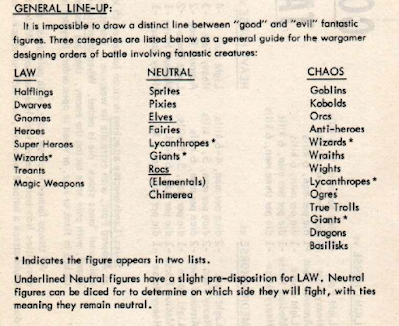
Alignment comes into D&D through its inclusion by Gygax in his game Chainmail. Below are the alignment charts from Chainmail's Fantasy Supplement and OD&D. Please note that these are basically the same chart, just reproduced twice. 

Chainmail "Alignment".

OD&D Alignment.

Alignment's original purpose was quite simple. In a wargame you need two sides to fight. In Historical Wargaming (which was virtually all wargaming back in Gygax's day really) that is kind of selected for you depending on what battle or time period you are playing in. But in a fantasy game of fantasy creatures, what do you do? Well, you do what Gygax did and simply slap everyone into 3 teams and give them an excuse to fight in a game about fighting. It is, honestly, one of the better game design decisions made by Gygax. 

And from here on out is where the whole "Alignment is like Nationalism" thing starts going. Because while the purpose of alignment - giving you a reason why your dudes should fight other dudes, was clear and concise very soon, within probably a decade at most from it's creation, Alignment started to change.

It started becoming about something more than just having a side so you can punch the dudes on the other side. In B2 the Keep is Law and the humanoids are Chaos. They are barbaric and "non-civilized" and all that other fun stuff you can read about from people who've already written about it. Alignment now could no longer be a simple "us vs them" thing, it had to stand for something greater. It had to Mean Something

Just as the process of getting a group of people to think of themselves as a nation, while having a common enemy is more or less a prerequisite (be it The Ottomans, The British or The Jews) sooner or later people come around to invent all kinds of peripheral stuff around it. Art, culture, traditions - things which are either created out of whole cloth or simply repurposed to somehow mean something else now (the meaning being "We are a Nation"). 

Alignment had the same thing happen to it. It started as a simple pretense for violence (again, just like nationalism!) but people were not content with that. It had to Mean Something. Suddenly Law and Chaos were not just a random football team you cheered for, no no. They were  Good and Evil (despite Gygax intentionally not labeling them that in the original version of alignment above). They were about Ethics and Morals and World Views and Cosmic Struggles. 

Suddenly your alignment started to matter a whole lot - Paladins could fall from grace if they acted against their alignment. Which lead to the famous Gygax postulation that a Lawful paladin slaughtering Chaotic orc children is somehow still Lawful and not, ya know, monstrously genocidal and evil (please just imagine that from now on I just add "ya know, just like nationalism" after every statement, because I hope I've made the point clear by now). 

Suddenly there were entire other planes of existence who's purpose was to give Meaning to your alignment. You weren't just "Lawful Good" meaning you were a good boy scout (who murdered the young of thinking people like orcs), oh no! No, there is now an entire infinite plane of existence devoted to the concept of Lawful Goodness. It can't possibly be arbitrary, after all look at how much ink had been spent printing books upon books of details about why your Alignment is totally an important thing and an important part of your character.

And on and on it goes. What's important to note here is that the backlash against Alignment is itself also just something that reinforces this mythologizing of it's importance. People who declare that Alignment is stupid and you can not possibly map ethics and morality onto a 9 point grid are still acknowledging the myth that this nine point grid somehow matters. It doesn't. 

Me though? I don't really dislike Alignment. I used to, mind you. Until I realized what Alignment is actually for. And what it's for is, as was stated earlier, was an excuse to provide you a simple pretense as to why you should fight in a game about fighting. And it does that job perfectly well. 

Tuesday, April 4, 2023

BSSS - Session 11

 Summary

This session was mostly confused on the final preparations for storming the inner gatehouse of the Eternal Bridge, and the actual fight itself and its consequences.

Characters

  • Maru the Witch - 4rd Level Diabolist Sorcerer
  • Rajini - 2nd Level Sorceress [Now Dead]
  • Athra - 4th Level Fighter
    • Gal-Naha the Giant Gecko - 3rd Level Giant Lizard
  • Arrim - 1st level Fighter
  • Alorus - 1st level Vivimancer Sorcerer

Session Recap

We pick up where we left off last time, with the party returning to the Undying City and using their last week of Downtime to prepare for the upcoming fight. The gatehouse was scouted, people went to buy extra equipment (and also animals for the new sorcerer's trick) and a chance encounter with one of the sorcerer-priests of the Pale Stillness of Justice ended up with him bound and gagged and his and his men's clothes appropriated for ease of entering into the locked down gatehouse.  They also got in touch with a contact for the cult of The Decomposition and agreed that the attack on the gatehouses and the bridge will happen early on the day of the grand procession itself.

There was also so much planning, preplanning and further planning with just trying to figure out how this small group of people are supposed to enter a fortified location and further more - take it over! 

This is where the action takes place.


Finally, as the session was moving ever closer towards its end time, we decided to finally begin with the meat of the scenario. The party managed to bullshit their way through the guards posted right outside the closed doors of the gatehouse, and got access to the inside and talked to the captain in charge of the garrison. However there was also another sorcerer-priest of the Pale Stillness also garrisoned in there (you never know what kind of nonsense can try coming in across the bridge from the old ruins) and he was suspicious of this religious brother of his claiming that there was an imminent Chaos attack that they had only been warned about just now. 

With him claiming to be sent here for back up, he decided now was the time to deploy his secret plan - two poisonous centipedes and 8 rats (the centipedes bought at absurdly inflated prices from a Golden Fraternity merchant specializing in rare and exotic animals) were deployed in the middle of the gatehouse passage, and then he began to cast a spell to transform them into gargantuan and monstrous versions of themselves. As the captain and the sorcerer-priest looked on, the party decided now was the time to strike and blasted the captain with magical lightning, the priest was quickly rushed to knock him out of the fight before he can wipe out half the party with his own magic, and then a bloody brawl began. 

All the while, out in the passageway of the gatehouse, the centipedes and rats kept growing and growing, eventually turning into monstrous and ravenous beasts. The archers deployed on the second floor then used the murder holes in the floor/ceiling and dropped alchemical fire on top of them, turning the small hallway into a living hell of sticky flame, smoke and marauding animals. 

In the ensuing fight several things happened - Maru the sorcerer managed to wipe out a large group of reinforcements coming from upstairs with the use of his Maleficence, Rajini was viciously struck down by several guards and killed on the spot for her attack on the captain, and some of the giant animals that managed to survive being bathed in fire and then shot at by arrows broke down both the city-side and bridge-side doors of the guardhouse and spilled out of there, tearing people, buildings and the bridge apart in their frenzy. The gatehouse was now wide open, with the remaining garrison panicking and retreating. 

The party mopped up the few remaining fighters and then using a Miasma spell they blinded the rest of the garrison that had moved on top of the building (a good defensive position against fighters. Not so great when it comes to magical clouds of demonic energies). 

 Battered, bruised and generally slightly worse for ware, but mostly alive (except the one who died that is) the party looked onto the bridge, seeing the outer and much bigger gatehouse fall before the army of Chaos, as they stormed down the now unprotected bridge (killing off the centipede and remaining giant rat on the way) and then rush into the streets of the Undying City.

The dawn had just broke, and with it the gates of the Temple District were opened and the procession started its ritual, yet unaware of what had transpired on the other side of the city.

Observations

This was quite a different thing for me to both organize and run as a referee. First off this was basically a set piece battle, really more similar in preparation to a wargame scenario than a typical dungeon crawl or exploration adventure. I mapped out the gatehouse, wrote up the garrison involved and even made sure to note on my map where every single person in that garrison was as the encounter began. 

Behold my very messy notes and map!

I really had no idea how the party was going to even do this either. The gatehouse was on lockdown, what with this being the big day and all that. 

Further more the session was run in the evening, rather than the usual Sunday noon time. There was discussion with some of my players and we are going to try doing evening games, which I do enjoy, but have the significant downside of rather strict time limitations - it can only get so late before everyone just starts getting tired and being done. A player, after the session, did raise the point that the tighter timeframe does mean that decisions are more rushed and sloppy. 

I actually agree with him, however for me that is not necessarily a bug in this case. Yes, time crunch means that players need to be way more precise with their plans and how much time they spend actually discussing things during the session, but to me that is, in some ways, just another aspect of the game. How you spend the time we have for the session is part of playing the game. 

Another big topic which was brought out from the session was that of experience points. Now for me it made no sense that any exp be granted for defeating enemies, as this would set a precedent where the party can decide to simply murder people and claim to get experience out of it, and I don't quite like that. So while I had thought about what and how much exp this should give, if any, on the night of the game itself I had kind of settled on it not giving any at all.

However, this I feel was a fault in my role as a referee. What I think is the correct way of handling his would have been to bring up the topic to my other players before the actual scenario was played. And here's why -  Because the point of experience for treasure retrieved and enemies slain, as far as I am concerned, is to provide specific clear goals at any given session as to what moves the characters forward. However this was not a typical session. There was no exploration, no dungeons, no wilderness. It was an assault on a fortified location in, what at least until now, was a friendly city to the party. Therefore the typical metrics of experience (money and monsters) were not valid. 

Conversely though, the party had a very clear and precise goal as to this specific scenario we played out - They needed to neutralize the garrison and also provide access to the Chaos army into the city. They achieved the goal of the scenario quite well I think, so in the end I made the decision as a referee to award each PC with 500 experience for it. I probably would have come to this decision even if it wasn't brought up by the players after the game, but it really should have been discussed beforehand.

With a larger gap between this and the next session, this will hopefully give me the time to discuss the scenario for that one and also what, if any, experience is to be earned from it. I have been re-reading Muster and its point on goal-oriented experience gain is what made me realize that I do think the players should earn experience for achieving the "win condition" of the scenario. 

Also, one of the players decided to not use his current character  for this, but instead made a new one (Alorus the Vivimancer) which I think was also good. I feel it's important that players be able to have multiple characters available that they can use depending on the situation. As long as this is not abused by trying to game the system (which can't happen, because that is what my role as a referee is for) and also those PCs are then treated as "active" in the campaign and therefore provided with accommodations and upkeep, of course. 

Lastly, another thing this session has now done is kind of break the basic structure of my campaign a bit. With this being ostensibly an open table (though with rather a stable core of players for a while now, and not many new faces joining in) each session needs to begin and end at a safe location where new players and party members can be slotted in and out depending on attendance. However right now the next session appears like it would need to take place immediately after this one, thus breaking that chain.

This, I feel, is mostly okay as an exception (and these are exceptional circumstances), though definitely not something I feel should become a regular part of the game.